
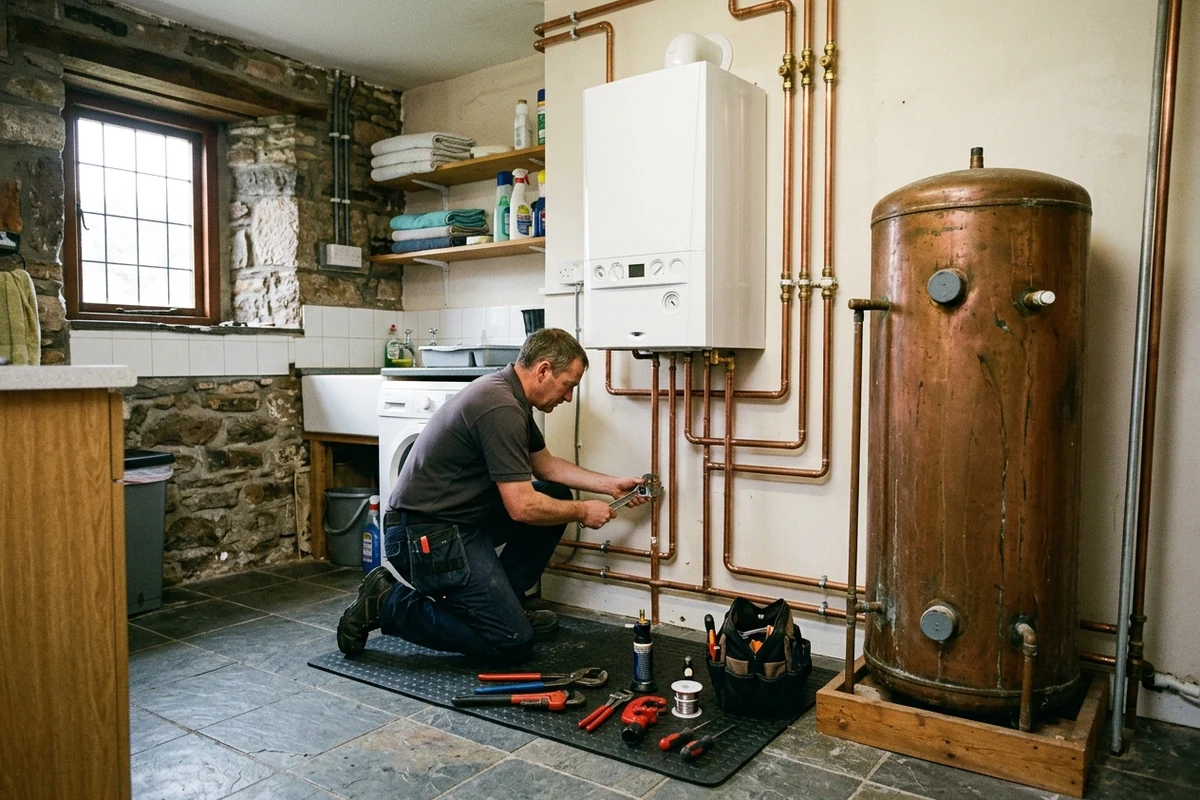
1. Why Glasgow Homeowners Are Converting to Combi Boilers
If your home was built before 2000 in suburbs like Bearsden, Newton Mearns, Giffnock, or Bishopbriggs, you likely have a traditional regular (conventional) boiler. This configuration relies on:
- A large cold-water storage tank situated in the loft or roof space.
- A smaller feed-and-expansion cistern in the loft.
- A copper hot-water cylinder located in an upstairs airing cupboard.
Converting to a modern condensing combi boiler replaces all these separate components with a single, wall-hung unit. You gain instant hot water on demand, eliminate the risk of freezing loft pipe bursts in sub-zero Glasgow winters, and reclaim valuable bedroom or hallway wardrobe space.
2. Attic & Cylinder Tank Removal: What Happens on Day 1
On the morning of the installation, vetted heating engineers isolate your mains water and drain down both the central heating circuit and the domestic gravity storage cisterns.
The copper hot-water cylinder is carefully unplumbed and removed from the cupboard. The large cold water cistern in the attic is drained, disconnected from the Scottish Water mains ball valve, and safely decommissioned. If the tank is too large to fit through the loft hatch, our engineers safely cut it down on site and remove all debris for certified recycling.
3. Fireplace Back Boiler Decommissioning (Baxi Bermuda)
Many 1960s to 1980s semi-detached homes across Glasgow (e.g. Knightswood, Croftfoot, Cardonald, Kings Park) still operate with obsolete back boilers hidden behind a gas fire in the living room chimney breast.
These units are typically only 60% to 65% efficient, wasting 35p of every £1 spent on gas. During a back-boiler conversion:
- The living room gas fire and heavy cast-iron boiler unit behind it are decommissioned and removed.
- The redundant chimney flue liner is safely capped and vented.
- A brand-new A-rated combi boiler is mounted in an optimal location (usually the kitchen, utility room, or hallway cupboard).
- A new 22mm or 28mm high-capacity copper gas line is run from the meter to guarantee proper burner pressure.
4. Testing Scottish Water Pressure: The 1.5 Bar Benchmark
A combi boiler does not rely on gravity; it heats water directly as it flows from the mains street pipe. Therefore, your shower pressure depends entirely on the incoming cold mains flow.
In Greater Glasgow, Scottish Water provides excellent natural water pressure (typically 2.0 to 3.5 bar), fed from reservoirs like Loch Katrine. However, before commencing any conversion, our vetted Gas Safe engineers perform a flow-cup and pressure gauge test at your outside stopcock or kitchen tap.
🚨 Checking for Old Lead Incoming Pipes
If your property still has an original 1/2-inch lead incoming main supply pipe, flow rates may be restricted to under 9 litres per minute. Our engineers verify incoming flow before commissioning to ensure your combi delivers an invigorating 12 to 14 L/min shower flow.
5. Why Chemical Powerflushing Is Essential During a Conversion
Old gravity systems accumulate decades of black iron-oxide sludge (magnetite) settling at the bottom of old steel and cast-iron radiators. If a new combi boiler is connected to this dirty pipework without a thorough cleanse, sludge immediately rushes into the boiler's compact heat exchanger, blocking the narrow waterways and causing overheating.
Every conversion arranged through The Online Boiler Company includes a full high-velocity chemical powerflush and the installation of a high-power magnetic system filter (such as an Adey MagnaClean), protecting your boiler warranty for up to 12 years.
6. 2026 Glasgow Conversion Cost Breakdown vs National Competitors
| Job Specification | The Online Boiler Company | British Gas / Scottish Power | Your Savings |
|---|---|---|---|
| Standard Combi-to-Combi Swap | £1,299 – £1,495 | £2,400 – £3,100 | Save £1,100+ |
| Conventional Tank-to-Combi Conversion | £1,695 – £1,995 | £3,400 – £4,200 | Save £1,700+ |
| Back Boiler & Fireplace Conversion | £1,995 – £2,295 | £3,900 – £4,800 | Save £1,900+ |
Case Study: Full Tank Conversion — Roman Road, Bearsden
"A 4-bedroom detached villa in Bearsden had an aging 1998 Potterton boiler with two cold tanks in the loft and a leaking copper cylinder. Our vetted engineers removed both attic tanks, rerouted pipework to a Worcester Bosch Greenstar 8000 35kW combi in the utility room, and powerflushed 12 radiators. Flow rate jumped from 8 L/min to 14.5 L/min across all showers."
Explore Boiler Conversions in Your Suburb:
7. Frequently Asked Questions
How long does a combi conversion take in Glasgow?
A standard system-to-combi conversion takes 1 to 2 working days. We ensure the heating and hot water circuit is re-established so your home is never left without warmth overnight in freezing weather.
How much does a combi conversion cost in Glasgow?
Through The Online Boiler Company direct wholesale supply model, a full conventional-to-combi conversion in Glasgow typically costs between £1,695 and £2,195 all-inclusive. This covers tank removal, disposal, magnetic system filter, chemical powerflush, and Gas Safe fitting. In comparison, national firms routinely charge £3,200 to £4,500 for the same conversion.
Can my existing radiators handle high mains combi water pressure?
Before converting, vetted Gas Safe heating engineers perform a thorough visual and pressure test on your existing radiators and valves. Converting from a low-pressure gravity system (approx 0.3 bar) to a sealed combi system (1.0 to 1.5 bar) puts higher pressure on old radiator valves. Our packages include checking all joints and replacing weeping radiator valves with high-efficiency thermostatic radiator valves (TRVs).
What happens to the old water tank in the loft?
Our vetted heating engineers fully drain, disconnect, and safely remove the redundant cold water cistern and expansion tanks from your loft or roof void. They are taken away for certified eco-friendly metal and plastic recycling, giving you back clean, usable storage space.