
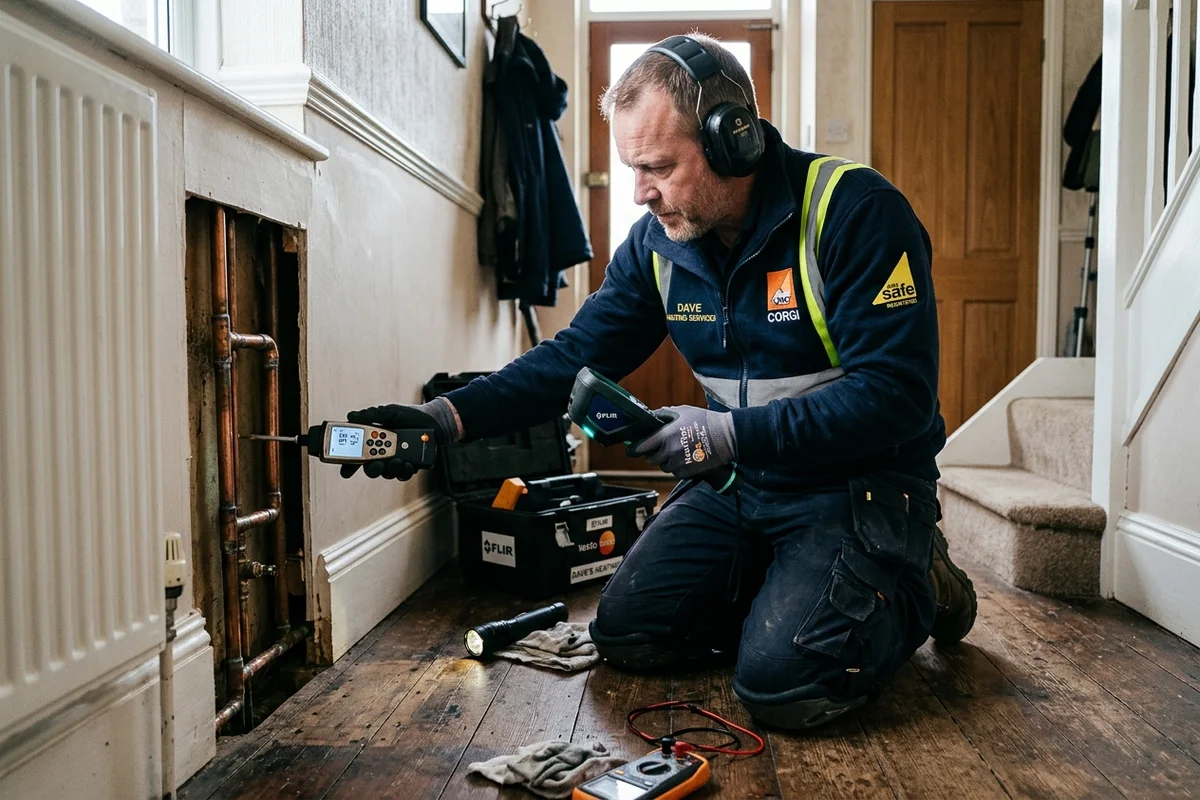
Summary & Technical Highlights
Why does your boiler pressure keep dropping? How to find hidden central heating pipe leaks, expansion vessel faults, and pressure relief valve issues.
✓ Fully verified against current Scottish Building Standards & Certified Heating Regulations.Overview & Key Takeaways
Having to repressurise your combi boiler once or twice a year is normal; slight pressure fluctuations occur with seasonal temperature changes and routine radiator bleeding.
However, if you find yourself opening the filling loop **every few days or weeks** because the gauge has dropped to zero, your central heating circuit has an active leak. Continually adding fresh tap water introduces dissolved oxygen and fresh Loch Katrine soft water into your radiators, accelerating internal rust and sludge formation.
The 2 Primary Culprits Behind Constant Pressure Loss
#
1. The Expansion Vessel & Pressure Relief Valve (85% of Cases)
When water inside your heating circuit heats up from 20\u00b0C to 70\u00b0C, it expands physically by approximately 4% in volume. To absorb this expansion, every combi boiler contains an internal expansion vessel\u2014a metal canister divided in half by a flexible rubber diaphragm, with pressurized nitrogen gas on one side and heating water on the other.
Over 5 to 8 years, the rubber diaphragm degrades, or the nitrogen charge leaks out: - Without an air cushion to absorb expansion, as soon as the heating fires, system pressure spikes rapidly from 1.5 bar up to 3.0+ bar. - To prevent pipes from bursting, the boiler's spring-loaded Pressure Relief Valve (PRV) opens, dumping excess hot water through a small 15mm copper pipe that exits through your external wall. - When the heating cools down at night, the water contracts, but because volume was dumped outside, the system pressure plunges straight to 0 bar.
The 10-Minute Plastic Bag Test: Go outside your home and find the small 15mm copper pipe that curves back towards the wall beneath your boiler flue. Tie a dry plastic sandwich bag tightly around the end with an elastic band. Turn your central heating on high for 30 minutes. If the bag fills with water, your internal expansion vessel is flat or ruptured, and your PRV is passing water. A heating engineer can repressurise the vessel with a stirrup pump or replace the bladder.
#
2. Micro-Weeps at Radiator Valves and Joints
If the external PRV pipe is completely dry, water is escaping somewhere inside your property: - Check every radiator valve (TRV) using dry tissue paper. Look for green or white crusty copper oxidation deposits around the compression nuts. - In Glasgow tenements with suspended timber floorboards, check ceilings below for subtle damp staining or plaster discolouration.
---
Need a Fixed Price for a New Combi Boiler in Glasgow?
Get an exact upfront trade wholesale quote online in 60 seconds. Guaranteed fixed pricing from £1,299 with zero sales pressure and zero upfront deposit.
Get Your Instant Fixed Quote →